

40 minutes
a day
80 lines at 30 seconds each, from one program to another.
Automated checks
Connections between programs
Custom management systems
The method
Technology
Technology: APIs, webhooks and connectors
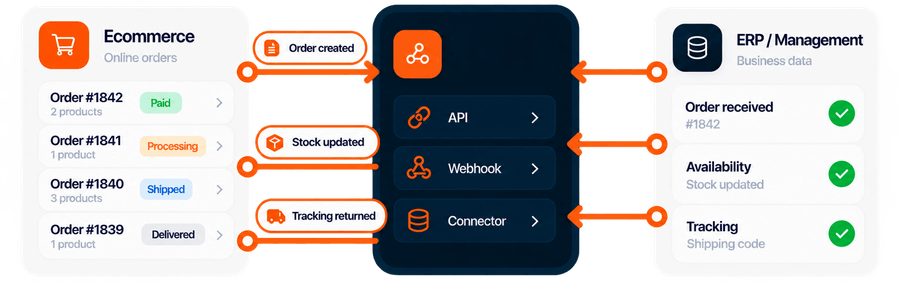
Every program has a way for data to get in and out: an API, an automatic notice, a file, a database. The connector uses them to take the right data to the right program, and flags it when something stops.
At a glance
How it works
The problem
The ERP knows the stock, the ecommerce site does not. Orders arrive on the website and are retyped into the ERP. Logistics waits for a file someone has to export.
Each manual handoff costs a few minutes, and now and then a mistake. Added up, it is hours every week.
In detail
The choice depends on what each program allows. A project often uses more than one.
One program asks another for data, or sends it, in an orderly way. The cleanest route, when it exists.
The program sends a notice as soon as something happens: a new order, a payment, a return. No waiting.
A CSV export every evening in a shared folder. Simple, and often enough.
Where it is allowed, data is read directly, without touching the program.
Documents that arrive as attachments, read and sorted automatically.
It translates codes between programs, decides which program leads on each piece of data, queues what does not get through and retries it. And it writes everything to a log: when an order does not arrive, you know why.
When it pays off
It makes sense if
You do not need it if
An example with numbers
Reference figures, to redo with your own.
40 minutes
a day
80 lines at 30 seconds each, from one program to another.
160 hours
a year
Over 240 working days: a person’s time for a whole month.
Once
the data is entered
Then it reaches the other programs on its own, with the right codes.
We already do it. For an online shop we built a warehouse system that updated stock on WooCommerce on its own, and in another project a connection built on Shopify webhooks. See the warehouse case
The limits
If the same item has three codes in three programs, you need a table linking them. Built once, then kept up to date.
Price, stock, address: for each piece of data only one program has the last word.
An update can change a format. The connector is adapted, and the log shows straight away what broke.
Stock yes, the price list maybe once a day. Updating everything every minute is wasted work.
Frequently asked
We use what it has: an export, a file in a folder, the database, a mailbox. We always start from how data leaves today.
Data stays in a queue and restarts when the program is back. If something stays stuck too long, a person gets an alert.
No. We build the connector and it runs on your servers. You pay for the development, not a fee.
It depends on the data. Stock every few minutes, or instantly with a webhook. Price lists once a day. Customer records when they change.
Yes. We start from the handoff that takes the most time, and add the others later.
Start with the problem
And where data moves by hand. We will tell you which connection to build first.
Prefer to write directly? [email protected]