

€17.10
not €17.00
A €20.00 price with a 10+5 discount comes to €17.10. Applying a flat 15% is 10 cents off per piece, on every line.
Automated checks
Connections between programs
Custom management systems
The method
Technology
Technology: rules and matching
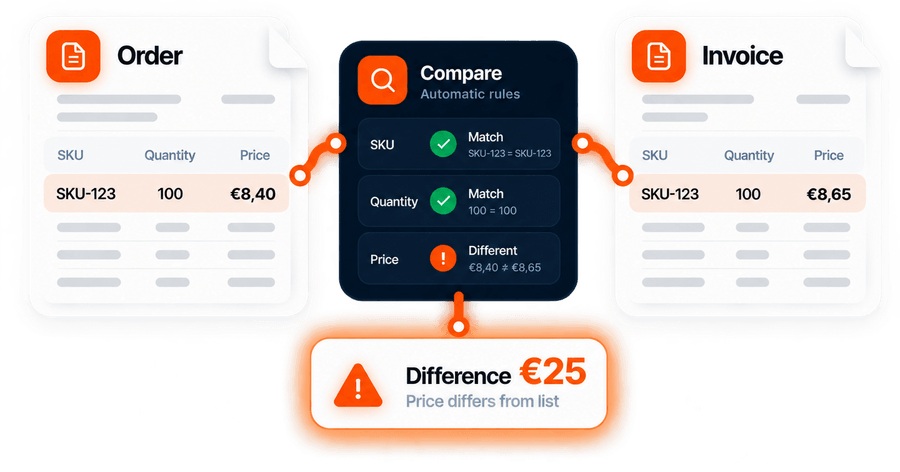
Checking an invoice means comparing it: with the order, the delivery note, the price list, the contract. The software does it with written rules, on every line, and shows you only the ones that do not add up.
At a glance
How it works
The problem
Every invoice should be compared with something: the contract rate, the price list, the quantities on the delivery note. The comparison itself is simple. The problem is doing it on hundreds of lines, every month, without mistakes.
So a sample gets checked, and the rest is paid on trust.
In detail
The real work is writing them well. Then the software applies them to every line.
Each invoice line is matched to its counterpart: the shipment in the contract, the item in the order, the code in the price list.
Rate by weight and zone, the price list valid on that day, cascading discounts, quantity breaks.
Billed against due, with the tolerances you decide, per supplier or per category.
Compliant, to check or wrong, with the reason written next to it.
Only the lines worth a look reach a person, with the figures needed to dispute them.
To compare an invoice line with a price list, a written rule is more reliable than a language model: it gives the same result every time, it can be verified and it says why. We use AI where it really helps, for example to read free-text descriptions. The decision about money stays with a rule and a person.
When it pays off
It makes sense if
You do not need it if
An example with numbers
Three typical cases, with the sums done.
€17.10
not €17.00
A €20.00 price with a 10+5 discount comes to €17.10. Applying a flat 15% is 10 cents off per piece, on every line.
+€30.00
on a single line
150 pieces at €2.40 instead of €2.20, because the price break above 100 pieces was not applied.
1%
tolerance
With a 1% tolerance, €10.08 on a €10.00 price passes. €10.40 goes to review.
The shipping statements case: every shipment recalculated against the contract, 100% of the lines every cycle, overcharges found from over 25% to over 70% on single shipments. Read the full case
The limits
The comparison starts from the contract or the price list. Without written agreements there is nothing to compare with.
When rates or price lists change, the rules change. In the shipping statements project the client updates them from a page of their own.
A surcharge the contract describes badly is not forced: it lands among the lines to check.
The software says what does not add up and what it is worth. The decision to dispute stays with a person.
Frequently asked
Because on prices and rates you need the same result every time, with a reason that can be verified. A written rule guarantees that, a language model does not. We use AI where it helps, for example to read free-text descriptions.
We write them from your contracts and price lists, and you verify them on real data before they are used.
The rule is updated. Where it makes sense, you get a page to do it yourself, without going through us.
Yes. We start with the one that weighs most, and add the others later.
A report with the compliant lines and the ones to look at, with the difference worked out and the reason. It exports to Excel or CSV.
Start with the problem
Which documents, compared with what, and how often. We will tell you which rules are needed.
Prefer to write directly? [email protected]