

Weight bands and DIM weight
Every shipment falls in its own band, and the billed weight can differ from what you expect.
Automated checks
Connections between programs
Custom management systems
The method
Technology
Logistics and shipping
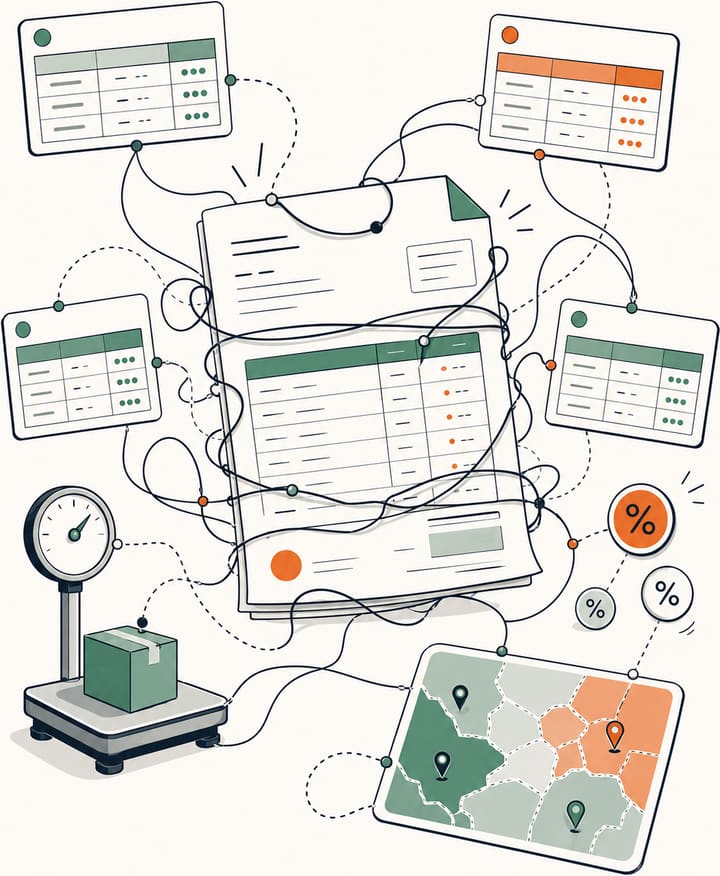
Weight bands, zones, fuel surcharges, DIM weight. Checking every shipment on the invoice or the shipping statement against the agreed rates takes hours, so usually only a sample gets checked. We build the software that checks them all before you pay.
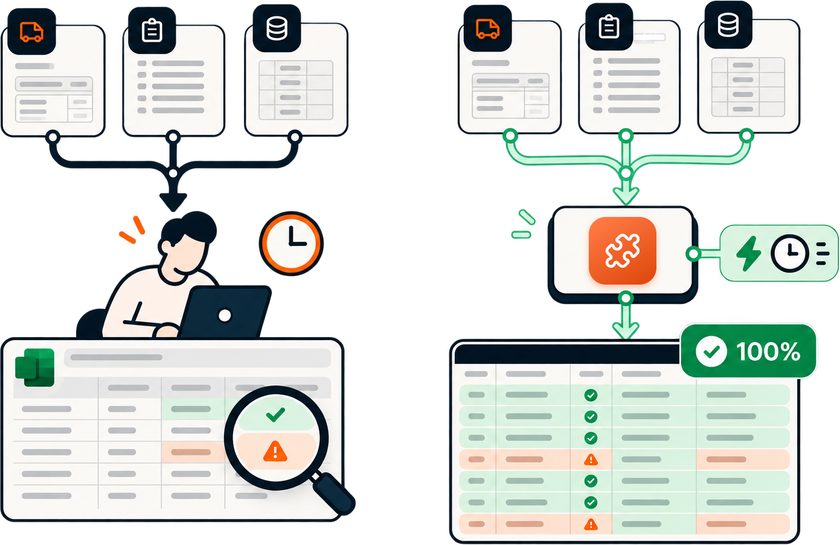
Real case From 2 to 3 hours of manual checking to a 2-minute upload.
Billed outside contract on 6 lines € 11.67
2 minutes, full cycle
Configurable for invoices from DHLUPSFedExDPDGLS and any courier with a rate card
Over 1% of a month’s shipping spend paid outside the contract: with those volumes, between €1,500 and €2,500 a year
Over 70% the highest overcharge, on a single shipment. The lowest one found was over 25%
2 minutes to check every line, instead of 2 to 3 hours on a sample
Numbers from the real project, generalised for confidentiality: the orders of magnitude are the real ones.
Free check
Before you decide anything, see the result on your own data.
One check per company, on a single invoice. It does not include checking every line, the following months or disputes with the courier.
Not the one who decides? Tell us anyway: we reply in writing, and you can forward the answer to whoever decides.
What it costs today
This is not an industry estimate. The comparison uses times measured on a real invoice verification project, where the manual check took 2 to 3 hours per cycle and the final report now takes about 2 minutes.
If your process is different the result changes, but the order of magnitude holds. It is there to show whether this is worth a conversation, not to promise a saving.
Try it with your numbers
The reference times come from a Levixflow project running in production on courier invoice verification. Your own result depends on the process, the data format and the controls you already have.
For industry context, Ardent Partners reports that on average 22% of invoices require manual intervention, compared with 9% in the most efficient organisations. Source: Ardent Partners, Accounts Payable Metrics That Matter in 2025
The problem
Not because anyone acts in bad faith. They are simply complex, and one wrong setting repeats across hundreds of shipments.
Every shipment falls in its own band, and the billed weight can differ from what you expect.
The rate changes by zone and service type. One wrong zone repeats across every similar shipment.
Fuel, storage, special deliveries, cash on delivery. Small items that add up.
A full check takes hours every cycle, so a sample gets verified and the rest gets paid.
22%* of invoices need manual intervention on average, compared with 9% in the most efficient organisations. Industry context. Source: Ardent Partners, Accounts Payable Metrics That Matter in 2025
Where errors come from
These are the places where a wrong rate goes unnoticed. Once in a while it does not matter. Repeated across hundreds of shipments, it does.
The courier bills the higher of actual weight and DIM weight: length times width times height, divided by a factor written in the contract.
For exampleA 60 × 40 × 40 cm parcel weighs 19.2 kg divided by 5,000 and 24 kg divided by 4,000. With the wrong factor you pay for 4.8 kg more on every parcel that size.
Rates go by band. A 10.2 kg shipment can land in the next band, depending on how the weight is rounded.
For exampleIf the band above 10 kg costs €1.60 more and the rounding is not the one in the contract, 300 parcels a month cost €480 more.
Islands, remote areas and historic centres carry their own surcharges. One postcode classified wrongly brings the surcharge to every shipment to that area.
For exampleA €3.50 surcharge applied by mistake to 40 shipments a month is €140 a month, €1,680 a year.
It is a percentage the courier updates every month. If the invoice keeps last month’s figure, the error hits the whole taxable amount.
For exampleOn €8,000 of shipments a month, a 14% surcharge instead of 12% is €160 more.
Cash on delivery, insurance, floor delivery or booked slots should only appear on the shipments that asked for them.
For exampleA €2 cash on delivery fee charged to 60 shipments that did not have it is €120 in a single cycle.
A parcel held in storage or returned to sender can be billed as a new shipment, instead of with the item the contract provides.
For exampleA return billed at €7.90 instead of the agreed €4.50 costs €3.40 more: 50 returns a month make €170.
The same shipment appears on two invoices, or twice on the same one. You only see it by comparing shipment numbers.
For exampleOut of 2,000 shipments a month, even 0.5% of duplicates means 10 shipments paid twice.
When the contract is renewed, the new rates apply from a precise date. Every shipment after that date has to use the new rate card.
For exampleAn old rate card costing €0.30 more per parcel, applied for two months to 1,500 parcels a month, is worth €900.
How the check works
The software reads invoice and shipping statement, recalculates every shipment with the rates in your contract and gives every line a status. Only the lines to look at reach a person.
| Shipment | Destination | Weight | Billed | Per contract | Status |
|---|---|---|---|---|---|
| 0001234 | Milan 20121 | 4 kg | €6.20 | €6.20 | Matches |
| 0001235 | Naples 80133 | 12 kg | €12.20 | €9.30 | Overcharge +31% |
| 0001236 | Bolzano 39100 | 2 kg | €5.40 | €5.40 | Matches |
| 0001237 | Lipari 98055 | 8 kg | €23.70 | €14.00 | Overcharge +69% |
| 0001238 | Florence 50122 | 6 kg | €8.90 | €6.90 | To verify: historic centre surcharge |
| 0001234 | Milan 20121 | 4 kg | €6.20 | already billed | Duplicate shipment |
Example with data that is not real. In the real project the overcharges on single shipments ranged from over 25% to over 70%, and over a whole month they came to over 1% of the spend.
Real case in production
A business with a high volume of shipments checked courier invoices and shipping statements in a spreadsheet, and could only ever verify a sample.
Before
2 to 3 hours
of manual checking every cycle, and only on a sample
After
About 2 minutes
to upload the files and get a report on every line
The program reads the courier PDFs according to each courier’s layout, recalculates the cost of every shipment to the cent with the contract rates and gives every line a status. The contract has its own page: the client updates the rates alone, without going through us. Results export to CSV or Excel, and the program runs on the client’s own server.
External service or custom check
Both can check the rates in your contract. What changes is where the data lives, how you pay and who handles disputes.
External service
Check built for you
An external service can be the right choice if you want someone to handle the disputes with the courier as well. With the custom check, the lines to dispute come with the numbers ready, but the dispute stays with you.
The data stays in the company
The terms you agreed with your courier are a competitive advantage. The program runs on your server, so they never pass through external services.
Before you write to us
It makes sense if
You do not need it if
What clients say
He understood the assignment, he asked good relevant questions and delivered excellent work that did not need correcting.
Verified review, anonymised for privacy.
Frequently asked
It is the list of shipments for a period, with weight, destination, services and cost of each one. The invoice often shows totals only: the shipping statement is where you see which shipment was overcharged.
Yes, as long as invoice and shipping statement arrive in a readable format, such as text PDF, CSV, Excel or XML. The program reads the files according to each courier’s layout, and the rules are written on your contract.
Length times width times height in centimetres, divided by a factor written in the contract, usually 4,000 or 5,000. The courier bills the higher of actual and DIM weight, which is why the right factor matters.
Each month’s percentage is recorded and the program applies it to the shipments of that period. If the invoice shows a different one, the line goes to verification.
It gets a status, such as to verify or overcharge, with the difference already calculated. From the report you export the lines to clarify with the courier.
No. The program gives you the lines and differences to dispute, with the numbers ready. The dispute stays yours.
You do, or whoever looks after it in the company. In the project running in production the client updates the rates alone, without going through us.
No. The check adds to what you already do. You upload the files and get the report.
Yes. It is built on the rates in your contract and tested on a real invoice cycle, before delivery.
Start with the problem
We will tell you whether an automatic check makes sense for your volumes. No commitment.
Prefer to write directly? [email protected]