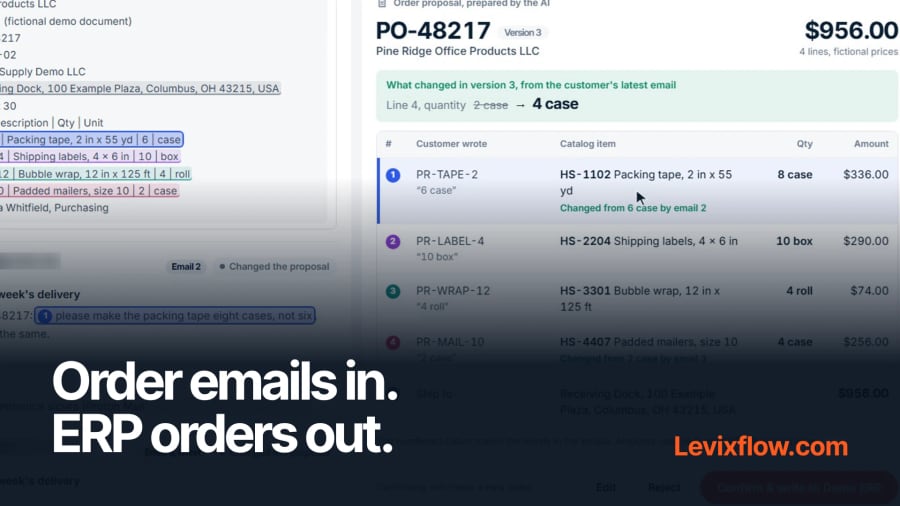
Custom software wins it back: from hours to minutes.
Orders to retype, invoices to check line by line, data to update in several programs. We study how your office works and build what it needs: an automation, a connection to the programs you already use, or a new management system.
a week to match payments and invoices, with reminders ready to approve
Real case
These are examples. We study every case first: we tell you whether and how it pays to step in, and if it does not, we say so.
The weak point
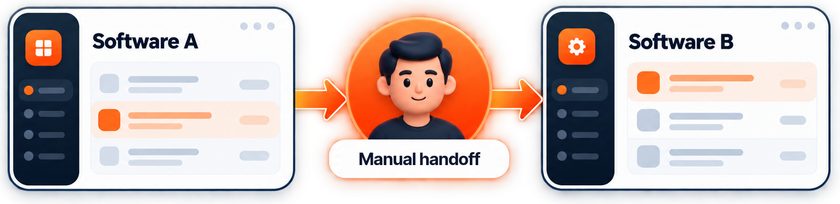
Retyping the same data from one program to another? We build the missing piece.
Orders in one program, invoices in another, stock in a spreadsheet: someone bridges the gap every day. The missing piece is a check or a connection that does that step in their place. It applies whether you make, distribute, sell online or provide services.
Automated checks
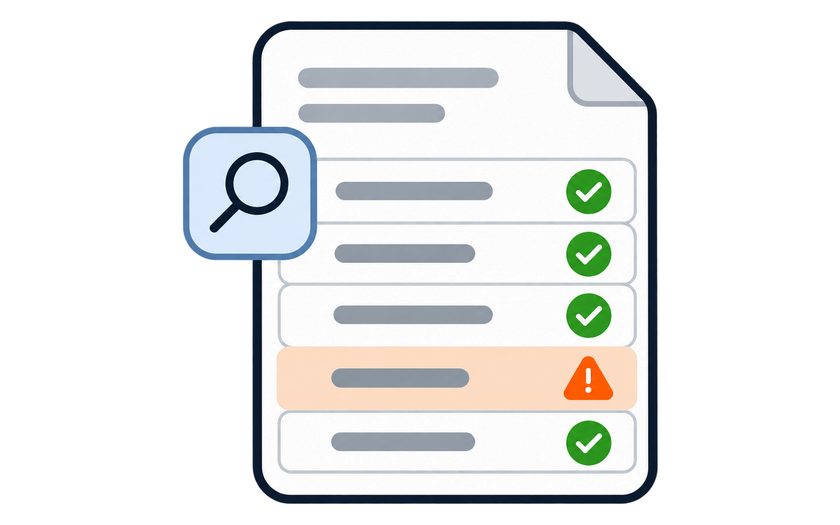
Invoices are still checked by hand, line by line.
The missing piece: an automatic check that verifies every line and shows you only the differences.
Real caseFrom 2 or 3 hours to 2 minutesfor each courier invoice, with every line checked instead of a sample.
Courier invoices to check? From 2 or 3 hours to 2 minutes.
A business with high shipping volumes was receiving courier invoices with hundreds of lines. Weight, volume, zone and surcharges made checking slow, and in practice only a sample ever got verified.
Before
2 to 3 hours
of manual review for every billing cycle
After
About 2 minutes
to upload the invoice and get the report
100%of lines checked every cycle
Over 70%overcharge found on a single shipment
Over 1%paid too much over a whole month
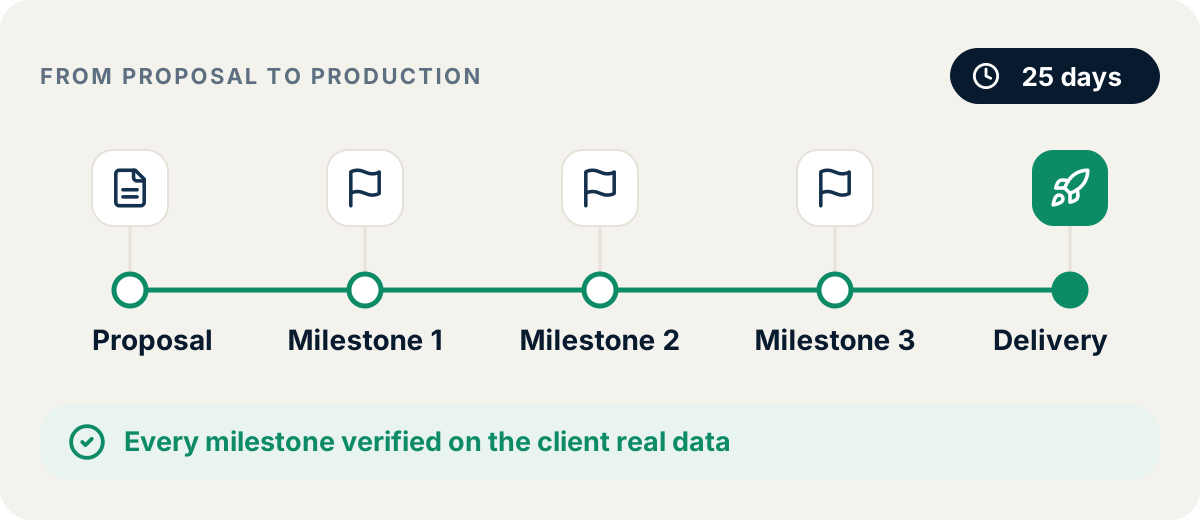
25 daysfrom proposal to delivery
The tool reads the invoice, applies the agreed commercial rules and produces a report containing only the lines worth looking at. Rates are updated by the client directly, without going through us.
After delivery, if you want, a monthly support plan: updates, small changes and a review every three months. It is optional: the software works without it.
Emails, PDFs and messages
Is someone in the office reading and retyping? That work can be automated.
Orders written in emails, documents in ever-changing formats, customers asking the same questions. Here the missing piece uses artificial intelligence to read, software to check and a person to confirm.
It arrives like this
Email from a customer
Subject: order for Thursday
Good morning,
we need 160 of the 40 brackets, 2500 wall plugs 8x40 and 312 blue labels.
Who looks after your project? The same person who writes the code.
There is no account manager collecting requirements and passing them on to somebody else. That shortens the timeline and reduces what gets lost along the way.
You talk to Seb, founder of Levixflow: 15 years of business software and integrations. About Seb
No code written before the process is understood.
1
You describe the symptom
What does not add up today. Orders to fix, invoices to check, data to retype, a spreadsheet that became critical.
Free, in writing
1
2
We map the data and the rules
Which systems are involved, which source is reliable, what you check today and which exceptions genuinely exist.
Before any proposal
2
3
You get scope, timeline and price
Written down before development starts. If the scope changes, we review it together.
Free quote, fixed price
3
4
We build and test on real data
In verifiable stages, testing against real cases including the errors and the exceptions.
Payment by stage
4
15 years of software development experience
Analysis of the real process before any proposal
Development in verifiable milestones
Testing on real data, exceptions included
You do not need to know APIs, databases or architecture. You need to know the operational problem well. The technical part is our job.
What clients say
Does it really work? Our clients say so.
Verified clientClient, web application
Sebastiano is a true professional. The communication was excellent, and the results were flawless. If you need someone competent to handle complex issues, he is the right person. Highly recommended!
Maintenance and fixes on an existing application, 2026 (extract)Verified clientClient, PDF data extraction
He understood the assignment, he asked good relevant questions and delivered excellent work that did not need correcting.
You explained exactly how you would approach the problem. That gave me the confidence to choose you.
Supplier selection for a software project (extract)
Verified reviews left by clients at the end of development projects. Names and commercial details have been removed for confidentiality. The text is the original or its English translation, in some cases as an extract.
Frequently asked
How much? How long? Here are the answers.
If yours is not here, write it in the form below.
How much does a project cost?
It depends on the scope. First the problem is analysed, then you receive a written proposal with a fixed price, timeline and what is included. The quote is free and commits you to nothing. Larger projects run in milestones and you approve one stage at a time.
How long does it take?
Focused interventions usually take 3 to 7 days. Medium complexity projects take 2 to 4 weeks. More complete back office systems take 4 to 8 weeks. Timeline and deliverables are fixed in the proposal, before work starts.
Do I need to buy a new ERP or replace my ecommerce platform?
Usually not. If the tools you already use do their jobs well, the goal is to connect them or add the specific control that is missing. Replacing a system only makes sense when the system itself is genuinely the problem. Your team keeps using the programs it knows: at most, a report or a screen for the exceptions is added.
Do I own the software or pay a subscription?
You own it. We do not sell a program on subscription: you pay for the development once, and the code stays maintainable by others too. After delivery you only pay for the changes you ask for, or, if you prefer, an optional monthly support plan.
Where does my data, and my customers’ data, live?
You decide. The software can run on your own servers, in your private cloud or on tools the company already uses, so invoices, contracts, price lists and customer data do not have to leave the business. Access and data processing are defined in the proposal, before any code is written.
What happens after delivery?
Issues within the agreed scope are still handled after delivery. Changes, new integrations or future improvements are agreed separately, always at a fixed price. If you want, an optional monthly support plan covers updates, small changes and a review every three months. The goal is to leave you with a stable tool and no surprises.
What kinds of problems does Levixflow solve?
The time and money an office loses on repetitive work, in companies of any sector and professional firms. Examples: courier invoices and statements to check, ERP, ecommerce and warehouse to connect, a critical spreadsheet to turn into a program, quotes with a configurator, apps for technicians and sales agents, payments and reminders, automatic reports from the ERP, customer and supplier portals, changing ERP, e-invoices read from the XML, orders and documents read with AI. We build the missing piece, a check, a connection or an app, or a management system or CRM from scratch.
Do you sell off-the-shelf software?
Not as the main model. Levixflow starts with the problem and builds the component that is actually needed. That might be a web app, connector, rules engine, local service or a focused operational interface. The software adapts to the process, not the other way around.
Do I need a technical person in the company?
No. You need someone who knows the operational process well, not necessarily someone technical. What matters is understanding what happens today: which files you use, which checks you run, where data gets stuck and who has to step in by hand.
Where do we start if I do not have a technical specification?
Start with a concrete description of the problem. Explain what happens today, which tools are involved, where something stops matching and what that costs the business. From there we map the technical scope and propose the next step.
How do I know whether the problem is worth a software project?
Start with the impact: hours spent, errors, lost margin, orders that need correction, controls that are skipped or dependence on fragile routines. If the expected benefit does not justify development, the right answer may be simplifying the process or using an existing tool better. If so, we will tell you.
Do you work with artificial intelligence?
Yes, where it helps. We use it when the work is reading and retyping: orders that arrive by email, documents in ever-changing formats, customer requests, answers locked in manuals. It is a tool inside the solution, not the starting point: the model interprets, software checks and a person confirms before anything is written or sent. Some call these AI agents or AI assistants. Where a rule is enough, we do not use it.
What does using AI cost, and where does the data go?
You pay model usage directly to the provider, through an account in your name whose keys you hold, with no markup from us: in our prototype on email orders it was $1 to $2 per 1,000 emails. With an outside AI service the text to read reaches that service, and one with servers in Europe can be chosen. If data must not leave the company, a model running on your own servers is used, on adequate hardware. The choice is made at the start and written in the proposal.
Are OCR and artificial intelligence always required?
No. If the data already exists in XML, CSV, a database or an API, using that source directly is often better. OCR and AI are tools to use only when they add real value to the specific case.
Do you work with companies outside Italy?
Yes. Levixflow works in Italian and English, with clients in Italy and abroad. Work is done remotely, by email and with video calls when they are useful.
Systems and technology
Do you have to change your programs? No, we work with the ones you have.
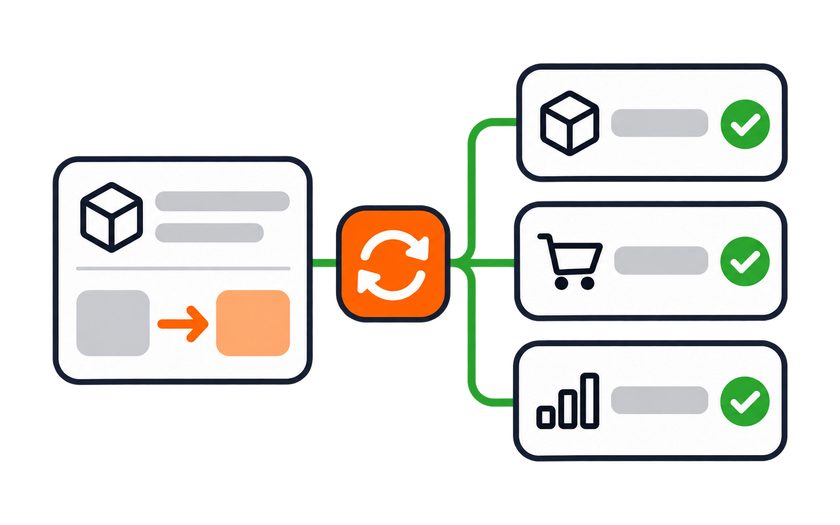
We connect the programs that already work instead of making you start from scratch. We start from how the data comes out today: an export, a file, an API, a database or an inbox.
EcommerceWooCommerce, Shopify, WordPress
ERP and management softwareThrough APIs, exports or the database
Excel and CSVThe files already moving around the office
Invoices and documentsPDF, XML, e-invoices, delivery notes
Couriers and suppliersRate cards, file layouts and billing files
Email and attachmentsThe documents that arrive every day
Built on mature, well documented technology
PHP
Laravel
Python
MySQL
Docker
REST API
WordPress
Cloudflare
First step, free
What costs you time or money? Tell us: we will say if it pays off.
No technical spec needed: describe what happens today, even in two lines. We reply in writing on four points.
Whether it pays to step in, and how
Which part to tackle first
Whether existing software already solves it better and cheaper
Whether a fixed price quote makes sense
If we go ahead: fixed price agreed upfront, payment by milestone.
This is not a free full audit and it commits you to nothing. If the answer is that nothing should be built, we will say so.
A more complex case? There is the Workflow Audit, a fixed price written analysis that is credited against the project if you go ahead. About the Workflow Audit