

2 hours
a day
5 people, 4 questions a day each, 6 minutes to search and answer.
Automated checks
Connections between programs
Custom management systems
The method
Technology
Technology: search with RAG
Procedures, manuals, product sheets, contracts: the answers exist, but only one person knows where, and every question goes through them. With RAG, whoever asks gets a written answer built from your documents, with the exact passage it comes from.
At a glance
How it works
The problem
How do we handle a return for a foreign customer? What is the procedure for a damaged parcel? What warranty does that product have? The answers are written down somewhere: in a PDF, in a manual, in an email from two years ago.
Usually only one person finds them. Every question interrupts them, and when they are on holiday the answers stop.
In detail
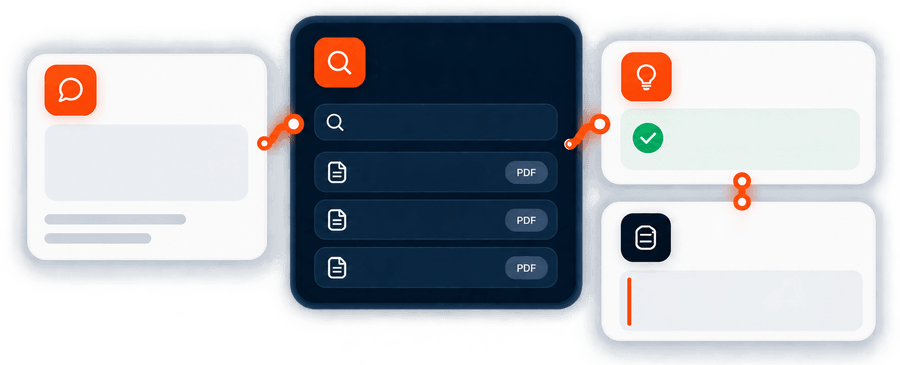
RAG stands for retrieval-augmented generation: first the right passages are found, then the answer is written using only those.
Procedures, manuals and sheets are split into short passages and indexed, so they can be searched by meaning, not only by word.
The question is compared with the index, and the system retrieves the few passages that really answer it.
A language model writes the answer using only those passages, and shows which document they come from.
If the answer is not in the documents, the system says so instead of making it up.
RAG is not for automating a process with fixed rules: comparing an invoice with a price list is done with rules, not with a model that writes text. And it does not replace your ERP: to know how much stock you have, you query the ERP, not a document.
When it pays off
It makes sense if
You do not need it if
An example with numbers
Reference figures, to redo with your own.
2 hours
a day
5 people, 4 questions a day each, 6 minutes to search and answer.
Over 40 hours
a month, from one person
Over 21 working days: the time of whoever knows where things are, taken from their own work.
With the source
every answer
Whoever asks also sees the passage, and checks it in one click.
How to start: a test on a set of documents and about twenty real questions, counting how many answers are right. Only then do you decide whether to extend it, and on which server.
The limits
That is why every answer quotes the passages it comes from, and can be checked in one click.
If a procedure is outdated, the answer will be outdated. Sources have to be kept in order.
Someone who cannot read a document must not get answers built on it. Permissions follow the documents.
Open models also run on premises, but they need memory and power in line with documents and users.
Frequently asked
Not necessarily. The system can run on your servers with open models, and documents stay in the company.
The risk exists with any language model. That is why the system answers only from the retrieved passages, quotes the source and says when it cannot find the answer.
PDFs, Word documents, manuals, product sheets, exported emails. Scanned documents go through OCR first.
A test on a small set of documents and real questions. You measure how many answers are right before extending it to everything.
It depends on how many documents and users. It is decided after the test, with real numbers, not before.
Start with the problem
Tell us about the documents and the questions that come up most often. We will tell you whether RAG is the right route, or whether something simpler will do.
Prefer to write directly? [email protected]